
Writing Fire
Art of Raging

I’m fired up and that means my thoughts start firing in the form of narratives laden with context, stories, and takeaways from lived experience. It’s funny how the process of sitting behind my laptop and committing to publishing is fueled by my rage, anger, sadness, and need to share or do something. In my creative act of raging, I first honor my grief, then I harness my rage as writing fire, and finally I feel gratitude for the experience.
I personally define writing fire as the ink fuel for passionate writing that sparks emotions, transformation, and action from writer to reader. To fully understand how I learned to harness writing fire, I must take a step back and travel through time to 2020 during the global pandemic and a civil rights movement that changed our society (and ourselves) in seen and unseen ways.
I lost more than I could emotionally and physically bear, leaving me in the liminal space between intense grief and immense rage.
1. The first loss was my grandfather due to respiratory failure. I remember vividly being masked up with a visor shield over my face, ready to wear a protective jumpsuit if it came to that, while on my way to visit my Napa (Grandfather) before COVID restrictions increased further, when I got the call. My stomach restricted instead and my heart dropped through the car floor and onwards through the road I was on, and perhaps even the Earth’s core.
2. The second loss was my 7.5-year relationship (that’s a long time). The reasons were many, like a house of cards or Jenga structure, not meant to last. Even though I initiated the end, it still hurt. I lost my best friend, my partner, a love I thought would last, and the future we talked about.
3. Our third loss was black lives lost too soon to murder, brutality, and injustice. This was during a global pandemic that was already claiming lives. Enough was enough, and my current position of influence wasn’t good enough to make a direct statement or change. I needed to get out there, in the field or the streets, and join the movement. Being able to document this activism journey in my first book served as a monument of remembrance for those individuals and a legacy for justice.
4. The fourth loss was my mentor, my first yoga teacher, and my beloved Bhavani, a University of Hyderabad professor I met when I studied abroad and visited India for the first time in my life in 2011. Growing up outside of my culture and in a household that predominantly emphasized assimilation, Bhavani was a breath of fresh air who welcomed me like the daughter of India I am, sharing the most raw, beautiful, and ugly things about our culture. She was real, she was about positive change, and she never stopped in that pursuit, even to her death.
5. Our fifth loss was a shame because it was my Uncle Buji, who had since moved back to India and who was so young, the youngest of all my father’s siblings (I had no immediate family in India the first time I visited and I always dreamed of going back to properly understand my roots and lineage).
6. Our sixth loss was what the profession of public health came to represent or rather how it was misrepresented, including the threats, turnover, and burnout that followed. Serving on the public health frontlines of the COVID-19 response symbolized both a highlight and hardship in my career because of the long hours (which weren’t always compensated), public skepticism and disregard of the prevention measures which made our jobs harder, and the mass exodus of public health professionals I admired.
Through all that loss, I was writing my first book. A 300+ page volume full of insights, interviews, stories, and frameworks on sustainable and regenerative travel. At first I really had no idea how I pushed through to write and publish this book amidst so much loss. I recall a conversation with my writing mentor about whether I should continue the process. This mentor was also a professor on book publishing and the reason behind why I was writing my first book. He said something along the lines of “perhaps there is no better time to write and share your message with the world than now, especially now.” When I emerged, slightly more healed, I realized that writing is my grace, my healing tool, my outlet through the pain and loss. I also realized that it is something that brings me peace and that even during my hardest, longest days, I can still commit to sitting down and writing.
These reflections also led to the realization that my childhood dreams of becoming an author had happened, and that perhaps I should lean into all my dreams instead of following someone else’s advice or a pre-defined career ladder. I find it beautiful that writing not only offered me the gift of my books and title of published author but also revived the hope I had for my dreams and future despite the loss and burnout.
I decided to take a leap of faith and follow my inner child again. My next move? Become nomadic. Three reasons for this dream from my childhood pushed up like roses from concrete.
1. As a child, I wrote and told stories about young adventurers traveling to far-away lands.
2. Long ago, I read a book (which I’ve been unsuccessful at finding since) about an American girl who traveled to all 50 US states with her family in a van.
3. My Nagymami (Grandmother) would tell us about our ancestral connection to the Mongolian nomadic tribes who traveled for thousands of miles to establish Hungary.
Even though I have lived nomadically for 5 years now, and have even written another book about it, the lifestyle continues to be challenging. I’ve simply gotten better at managing and working through those challenges over time with writing as one of my greatest tools on the road.
And so this is how the Nomad Writer rages on the road.
Sometimes I find myself crying or shouting (within the safety of my car) at the loss of a friend or lover who took the next exit from the highway that is my life. Later that evening, after perhaps a 4 or more-hour drive, I write my feelings, reflections, and thoughts.
Sometimes I am disappointed at the ways in which my global connections, sometimes relatives, won’t show up upon my arrival in their country. I write and the words, illuminating like hints on a treasure map, show me how I’ve figured out how to navigate these stormy seas on my own, empowering me with a greater sense of agency in my journey.
Sometimes I am annoyed at the questions or judgements I receive for choosing this life such as “what am I doing with my life?” “am I really working?” “when will I get serious?” “don’t I feel like I’m missing something?” Through writing, I answer these questions for myself and no one else to feel clear in my purpose, hyperaware of my transformations, free in my movements, proud of my seriously hard work to pull off logistics, and filled with gratitude for the journey.
Sometimes I find myself so overwhelmed by the ideas, people, learnings, and differences between each new place I visit, that my mind rages with thoughts. Writing those down as half-baked notes that take shape as I delve deeper into understanding their roots, their history, and how they apply to my life, help me sort through the noise, find a signal that resonates, and make sense of it all. In exposing myself to thousands of stimuli and testing my brain with hundreds of decisions regularly, writing becomes the necessary world processor.
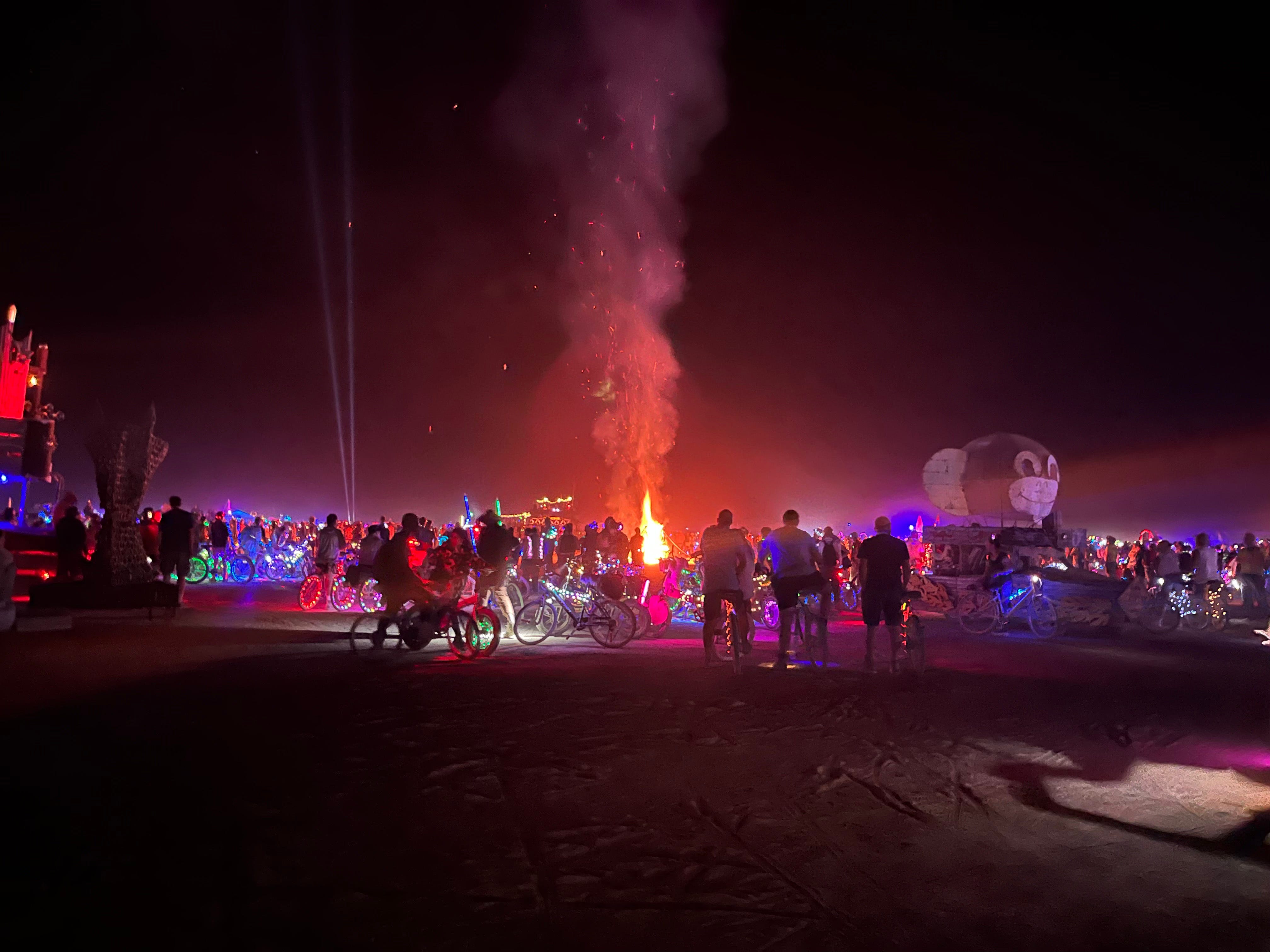
I found myself at the Burn. My writing and nomadic journey took me to Burning Man: Waking Dreams. On display in the middle of a nowhere desert was the largest art rager I’d ever witnessed. Thousands of humans off-grid, living in radical self-sufficiency, abiding by the leave-no-trace behind principles, and full of fire, creativity, and humanity. Fire burned in creative ways on creative art structures. Within the dust-filled tents or on the playa (the open expanse of desert where the ‘man’ burns), we shared ideas, burning with a passion for a different, more communal, and equitable world. And so I wrote.
There are times where ideas for written pieces flow freely and other times where the dreaded writer’s block literally blocks my mental view. When I tap into what fires me up or when I’m fired up by something, I can write for hours. My rage is also my gratitude because I am grateful that I feel and care so deeply about a cause that I can use my gifts to communicate thoughtfully with the world about them. My hope is that you’ll discover the causes, whether they inspire rage or gratitude or both, that refill your inkwell.
A few writings that inspired this written piece:
· It’s a myth that suffering makes you stronger & The Misfit’s Manifesto: https://ideas.ted.com/its-a-myth-that-suffering-makes-you-stronger/
· How to Write Through Grief and Find Creativity: https://www.writersdigest.com/be-inspired/how-to-write-through-grief-and-find-creativity
· Art After Loss: Creating Space for Grief, Connection, and Reflection: https://medium.com/high-museum-of-art/art-after-loss-creating-space-for-grief-connection-and-reflection-7ab2a1113643
· Exploring the Impacts of an Art & Narrative Therapy Program on Participants’ Grief and Bereavement Experiences: https://pmc.ncbi.nlm.nih.gov/articles/PMC11528868/
· The written songs of Kid Cudi (the musician and multi-hyphenate creative) and his album Man on the Moon II: The Legend of Mr. Rager